El Salvador Traditional dinner medium
El Salvadorian Pupusas
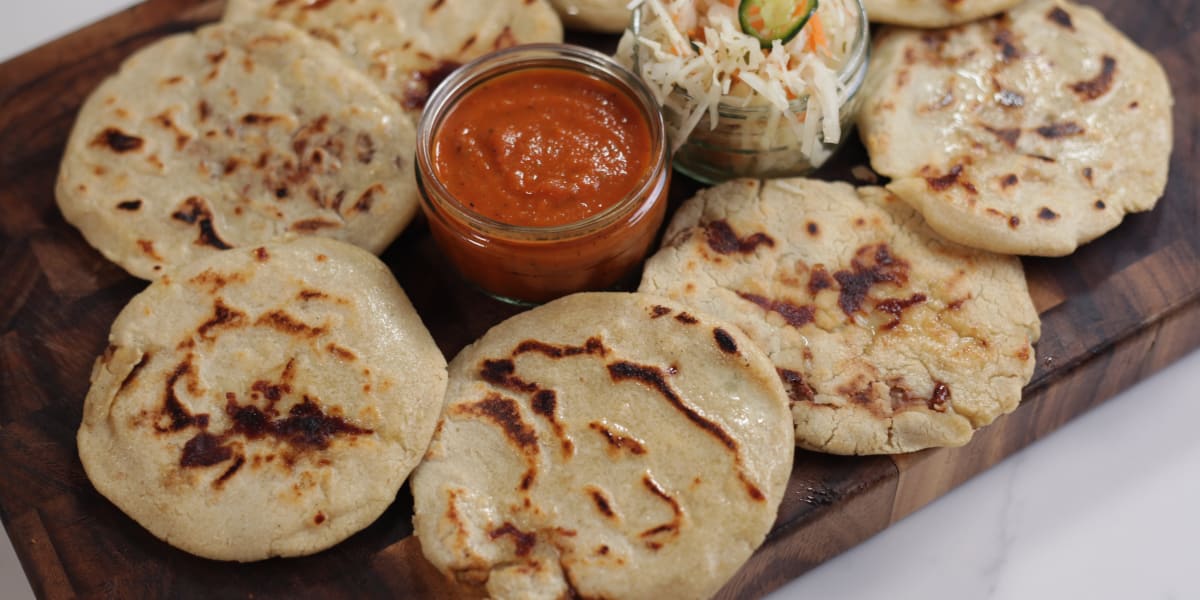
El Salvador's iconic national dish — thick handmade masa corn tortillas stuffed with chicharrón or refried beans and cheese, served with tangy pickled curtido slaw and charred salsa roja.
Prep: 40 min
Cook: 60 min
Serves: 4
#el-salvador
#pupusas
#masa
#chicharron
#curtido
#central-american
#national-dish
#corn
El Salvador’s iconic national dish — thick handmade masa corn tortillas stuffed with chicharrón or refried beans and mozzarella, served with tangy pickled curtido slaw and charred salsa roja. Make the curtido the day before if you can; it only improves with time.
Instructions
Curtido (make ahead)
- Finely slice the cabbage, onion and jalapeño (a mandolin helps). Peel and grate the carrot.
- Pour boiling water over the cabbage — just enough to cover — and let it sit for 1 minute, then drain. This softens it slightly and takes the edge off any bitterness.
- Combine all the curtido ingredients in a bowl, season with salt and pepper, and stir well.
- Cover and refrigerate for at least 2 hours, ideally overnight.
Chicharrón Filling
- Place the pork chunks, garlic cloves, and salt in a pot or wok. Cover with the cold water — about 2 cups.
- Bring to a boil then reduce to medium heat. Cook for around 30 minutes until all the water has evaporated. As the water disappears, the pork will begin frying in its own rendered fat. Let it colour until nicely browned all around. Add a splash of oil if it starts sticking, and a splash of water to lift any fond from the bottom of the pan.
- Add the chopped onion, tomato and green pepper. Cook for a further 5 minutes.
- Transfer everything to a food processor, season with black pepper, and blitz to a thick paste — almost like a pâté. Set aside.
Refried Beans Filling
- Heat the lard or oil in a skillet over low-medium heat. Add the diced onion and cook for 8 minutes, stirring occasionally.
- Add the garlic and cook for a further 2 minutes.
- Tip in the drained pinto beans, season with salt, and add the water. Cook until the water evaporates, which will soften the beans further.
- Mash the beans to a rough paste. Add a small splash of water if the mixture looks too dry. Set aside.
Salsa Roja
- Place the chopped guajillo chilli in a small bowl, cover with boiling water, and leave to rehydrate for 15 minutes.
- Meanwhile, place the onion chunks and halved tomatoes cut-side up on a baking tray with the unpeeled garlic cloves. Drizzle with oil and place under a preheated grill for 6–8 minutes until the skin is charred in places.
- Squeeze the roasted garlic out of its skins.
- Add the charred veg, peeled garlic, rehydrated guajillo chilli with a little of its soaking liquid, oregano and stock cube to a blender. Blend on high until smooth. Season with salt to taste.
Masa
- Combine the masa harina and salt in a large bowl. Gradually pour in the warm water while mixing with your hand.
- Knead for about 3 minutes until a smooth dough forms — you’re looking for a play-doh consistency. If it sticks to your fingers, add a little more flour. If it feels dry, add a splash more water.
- Divide into 8 equal portions of around 75g each.
Shaping and Filling the Pupusas
- Keep a small bowl of water nearby and dip your hands between each pupusa.
- Roll each portion into a ball then flatten it by tossing it between your palms until it’s roughly the size of your hand.
- For beans and cheese pupusas: add 1 tablespoon of refried beans and 1 tablespoon of grated mozzarella to the centre. Fold the edges up and around the filling, pinching to seal, then flatten again by patting between your palms to roughly its previous size. Repeat for 4 pupusas.
- For chicharrón and cheese pupusas: repeat the same process with 1 tablespoon of chicharrón paste and 1 tablespoon of mozzarella. Repeat for the remaining 4.
- Patch any cracks with a little extra masa.
Cook
- Heat a dry cast iron skillet or comal over medium-high heat — no oil.
- Cook the pupusas for 3–4 minutes per side until they have some colour and the masa is cooked through.
Serve
- Serve hot alongside the curtido and salsa roja. Use the curtido generously — it cuts through the richness and is as important to the dish as the pupusa itself.